
How Smart Marketers Master Online Paid Ads to Drive Growth
How to Make Online Paid Ads Work for Your Business

To make online paid ads work, start with one goal: leads, sales, or store visits. Choose a channel that fits how customers find you, set a budget you can afford to test, and send each ad to a page that matches its promise. Track the cost of each lead or sale. Improve what is not working before you spend more.
Search ads can reach people ready to act. Social and video ads can introduce your business to people who do not know it yet. The right mix depends on your customers and your goal.
How Paid Advertising Mechanics Work Across Modern Ad Auctions
Digital advertising has evolved dramatically from the early days of simple web banners. Behind every search query and social feed refresh sits a sophisticated ecosystem running programmatic auctions in milliseconds.
When a user loads a webpage or searches for a solution, publishers make ad inventory available through Supply-Side Platforms (SSPs) and Ad Exchanges. Simultaneously, Demand-Side Platforms (DSPs) evaluate the user's intent and context, placing real-time bids on behalf of advertisers. The winning bid serves its creative almost instantly.
Winning an auction does not solely depend on who bids the highest. Search engines and advertising networks use calculated metrics to protect user experience. According to official Google Ads documentation, placement is determined by Ad Rank. Ad Rank is calculated using your maximum bid, ad relevance, expected click-through rate (CTR), landing page experience, and the expected impact of ad assets.
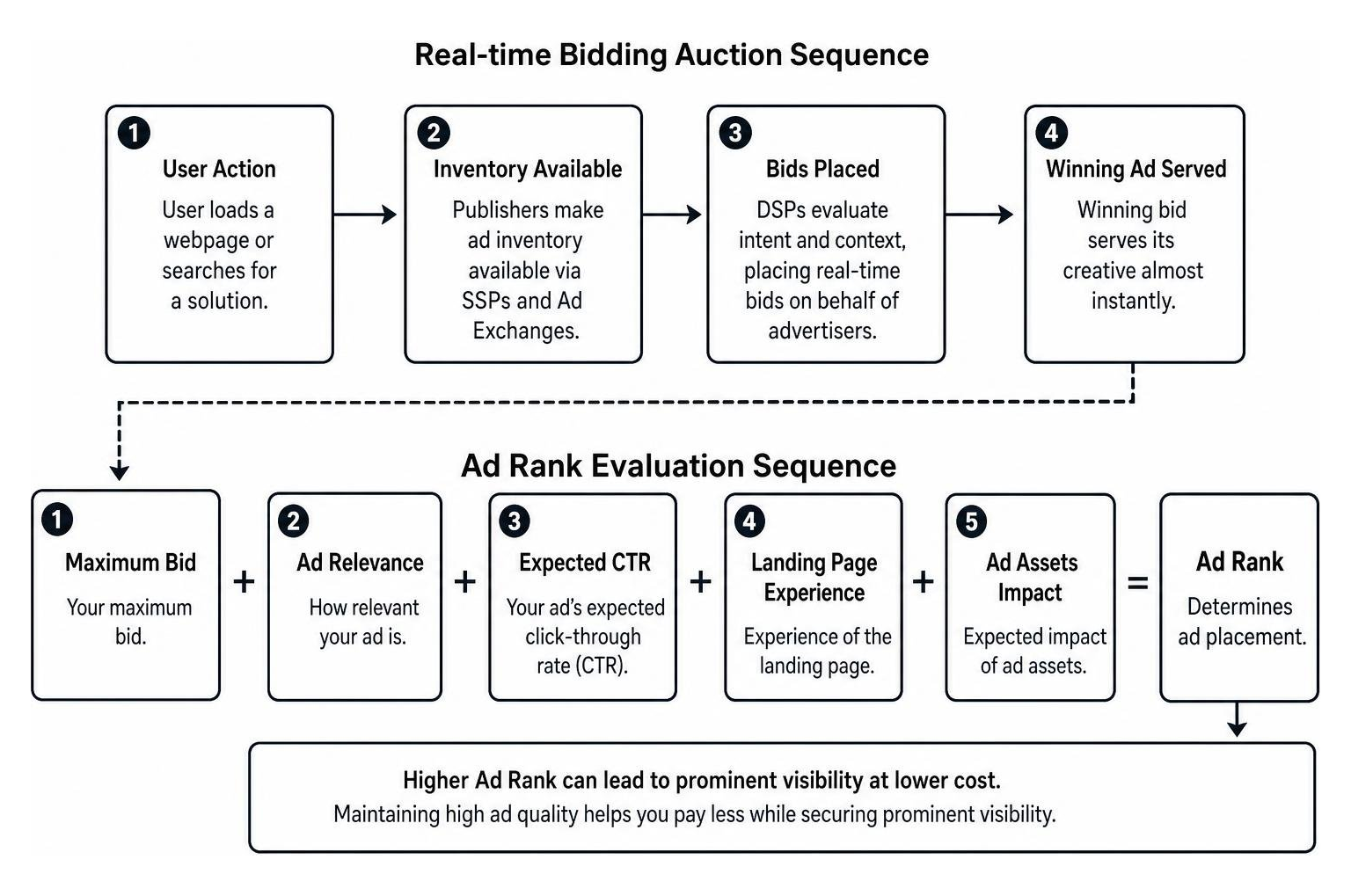
Maintaining high ad quality ensures you pay less while securing prominent visibility. Furthermore, tracking ad viewability is vital: historical studies from comScore found that roughly 31% of ads were never in-view when rendered. Ensuring your placements appear in authentic, viewable spaces protects your ad dollars from impression fraud and accidental clicks.
Pay-Per-Click vs. Impression-Based Models
Choosing the right compensation model aligns your media spend directly with your campaign targets:
- Cost-Per-Click (CPC) / Pay-Per-Click (PPC): You only pay when a user actively clicks on your creative. This model is ideal for direct-response lead generation, product sales, and capturing high-intent search traffic.
- Cost-Per-Mille (CPM): You pay a set rate for every 1,000 impressions rendered. This model suits brand awareness campaigns, video reach, and broad top-of-funnel exposure where visibility is the main objective.
- Cost-Per-Acquisition (CPA) / Cost-Per-Lead (CPL): Performance-based models where automated bidding algorithms optimize specifically to deliver completed form submissions or purchases within a target cost range.
Multi-Touch Attribution and Conversion Tracking
A customer rarely buys the first time they see a business. In fact, research shows that 67% of users who encounter brands on social media are subsequently influenced by search queries to purchase a product or explore competitors.
Tracking these touchpoints requires robust conversion tracking using first-party data and server-side pixels. By linking your web analytics, product catalog, and CRM data directly to your ad platforms, you can evaluate multi-touch attribution. This gives full credit to the discovery channels that introduce prospects to your brand, as well as the search ads that close the sale.
Core Formats of Online Paid Ads and Where to Deploy Them
Every ad format serves a distinct purpose across the customer journey. As outlined in the Amazon Ads paid advertising guide, selecting the right format depends heavily on your audience's media habits and where they make purchasing decisions.
High-Intent Search and Local Service Placements
Search engine marketing captures users at the bottom of the funnel when intent is highest. When a potential customer types a query into Google, they are looking for immediate answers or service providers.
For service-based businesses, local search placements generate qualified phone inquiries and appointment bookings. Managing these campaigns requires precise keyword match types, negative keyword pruning, and asset extensions. Professional Google Ads management ensures campaigns capture motivated searchers without wasting spend on irrelevant queries, as demonstrated in our local service advertising case study.
Social Media and Short-Form Video Advertising
Social feeds on platforms like Meta, Instagram, and TikTok allow brands to blend sponsored messaging natively into user feeds. Rather than waiting for a customer to search, social ads generate interest by presenting creative solutions directly to targeted demographics and interest groups.
Engaging audiences through targeted social media ads allows businesses to build brand affinity and retarget past site visitors. Furthermore, scaling sales with TikTok ads provides exceptional engagement for visual products, lifestyle brands, and dynamic offers.
Programmatic Display and Streaming Placements
Display networks and Connected TV (CTV) placements expand your reach across millions of high-traffic websites, mobile apps, and streaming networks. While static banner ads can suffer from banner blindness, programmatic contextual targeting places your message adjacent to relevant editorial content.
Combining dynamic retargeting banners with streaming placements keeps your brand visible throughout longer sales cycles, ensuring prospects return when they are ready to complete their purchase.
Step-by-Step Framework to Launch Profitable Campaigns
Launching a successful campaign requires moving methodically through strategy, audience targeting, funnel design, and creative testing. Before allocating ad spend, it helps to understand where to spend ad dollars across competing channels.
Defining Business Goals and Channel Selection
Begin by setting SMART (Specific, Measurable, Actionable, Relevant, Time-bound) objectives. Are you looking to generate 50 qualified B2B sales calls this month, or drive 300 e-commerce purchases at an average order value over $75?
Your goals dictate your channel mix. High-ticket B2B solutions thrive on LinkedIn and Google Search, whereas visual consumer goods and online courses excel on Meta and TikTok. Take the time to evaluate what to consider in your paid social strategy, ensuring your audience personas align with the platform's user demographics.
Setting Budgets and Funnels for Online Paid Ads
You do not need a massive corporate budget to see meaningful results. A manageable starting budget of $15 to $30 per day per platform is often enough to feed ad algorithms with conversion data.
Follow these budget allocation principles:
- Test Small Before Scaling: Allocate 70% of your budget to proven, high-intent channels (like Search or core retargeting) and 30% to experimental top-of-funnel creative testing.
- Benchmark Your Lead Costs: Aim for a target cost per lead between $2 and $5 for low-friction lead magnets, adjusting upward for specialized B2B consultations.
- Build Dedicated Funnel Pages: Never send paid traffic to an unoptimized homepage. Ensure landing pages load quickly and achieve at least a 20% conversion rate on free offers or lead magnets.
- Target Sustainable ROAS: Mature, optimized paid ad funnels typically operate around a 2x to 4x Return on Ad Spend (ROAS), balancing customer acquisition costs against lifetime customer value.
Creative Production and High-Converting Copy
Your creative assets represent your frontline sales team. In modern digital advertising, raw, authentic video clips recorded on a smartphone frequently outperform overly polished studio productions.
When producing ad creatives:
- Hook Viewers Instantly: Capture attention in the first three seconds by highlighting a specific pain point or presenting an intriguing visual question.
- Speak Directly to Benefits: Clearly articulate how your product solves a problem rather than merely listing technical features.
- Match Message to Landing Page: Maintain consistent imagery, headlines, and tone between your ad creative and destination page to avoid confusing visitors.
- Plan Seasonal Angles: Refresh messaging early for peak retail moments by building high-impact holiday ad campaigns tailored to seasonal shopping behaviors.
Optimizing Performance, Overcoming Hurdles, and Scaling
Launching a campaign is only the beginning. Consistent monitoring, data analysis, and technical adaptability ensure long-term profitability.

Key hurdles and how to address them include:
- Ad Fatigue: When frequency climbs and CTR declines, introduce fresh creative variations, new hook angles, and updated headlines weekly.
- Ad Blockers and Tracking Loss: With approximately 27% of internet users utilizing ad blockers, rely on first-party data capture, server-side tracking, and contextual targeting rather than invasive third-party tracking scripts.
- Holistic Social Integration: Maximize every dollar spent by incorporating paid ads into your social strategy to amplify your best-performing organic content.
How AI Transforms Modern Online Paid Ads
Modern advertising platforms rely heavily on artificial intelligence to optimize campaign performance in real time. Features such as Google AI Smart Bidding, Performance Max, and Advantage+ targeting process millions of contextual signals, including device type, time of day, browsing context, and user history, to bid on high-intent prospects.
Rather than manually tweaking keyword bids every hour, marketers now focus on providing high-quality creative assets, accurate first-party conversion data, and strategic audience guardrails. The AI engine then finds the most efficient conversion paths across Search, YouTube, Maps, and social feeds.
Blending Paid Acquisition with Organic Marketing
Paid advertising and organic marketing work best as a unified system. Organic marketing and SEO establish domain authority, build trust, and nurture communities, while paid ads offer immediate visibility, predictable reach, and accelerated testing.
Insights gathered from top-performing search ads reveal valuable keyword intent to incorporate into your organic SEO strategy. Similarly, top-performing organic social posts make great candidates for paid amplification to reach broader audiences.
Frequently Asked Questions About Online Paid Ads
How can advertisers overcome ad blockers and privacy tracking restrictions?
Advertisers can mitigate tracking limitations by setting up first-party data capture, utilizing server-side conversion tracking (such as Meta Conversions API and Google Enhanced Conversions), and focusing on contextual placements. Encouraging early email sign-ups via high-value lead magnets also reduces long-term reliance on third-party retargeting cookies.
Why do search ads convert better than standard social or display ads?
Search ads convert at higher rates because they capture active commercial intent. When users search for a specific product or service, they are actively looking for a solution. In contrast, display and social ads reach users while they are browsing other content, requiring compelling hooks to generate interest.
Conclusion
Mastering online advertising is not about gambling with ad spend; it is about building a measurable, data-driven customer acquisition engine. By aligning campaign objectives with the right platforms, testing creative hooks systematically, and integrating first-party data tracking, businesses can turn paid ads into a predictable growth channel.
Ready to turn online paid ads into a measurable growth channel? Contact The Small Social Company to discuss a paid advertising strategy built around your business goals. Our women-owned agency offers paid advertising, social media management, branding, SEO, website design, email campaigns, influencer marketing, and video production, all focused on meaningful engagement and real business results.


