
Master the Bridge Between Content Marketing and Business Strategy
How Content Marketing and Strategy Support Business Growth

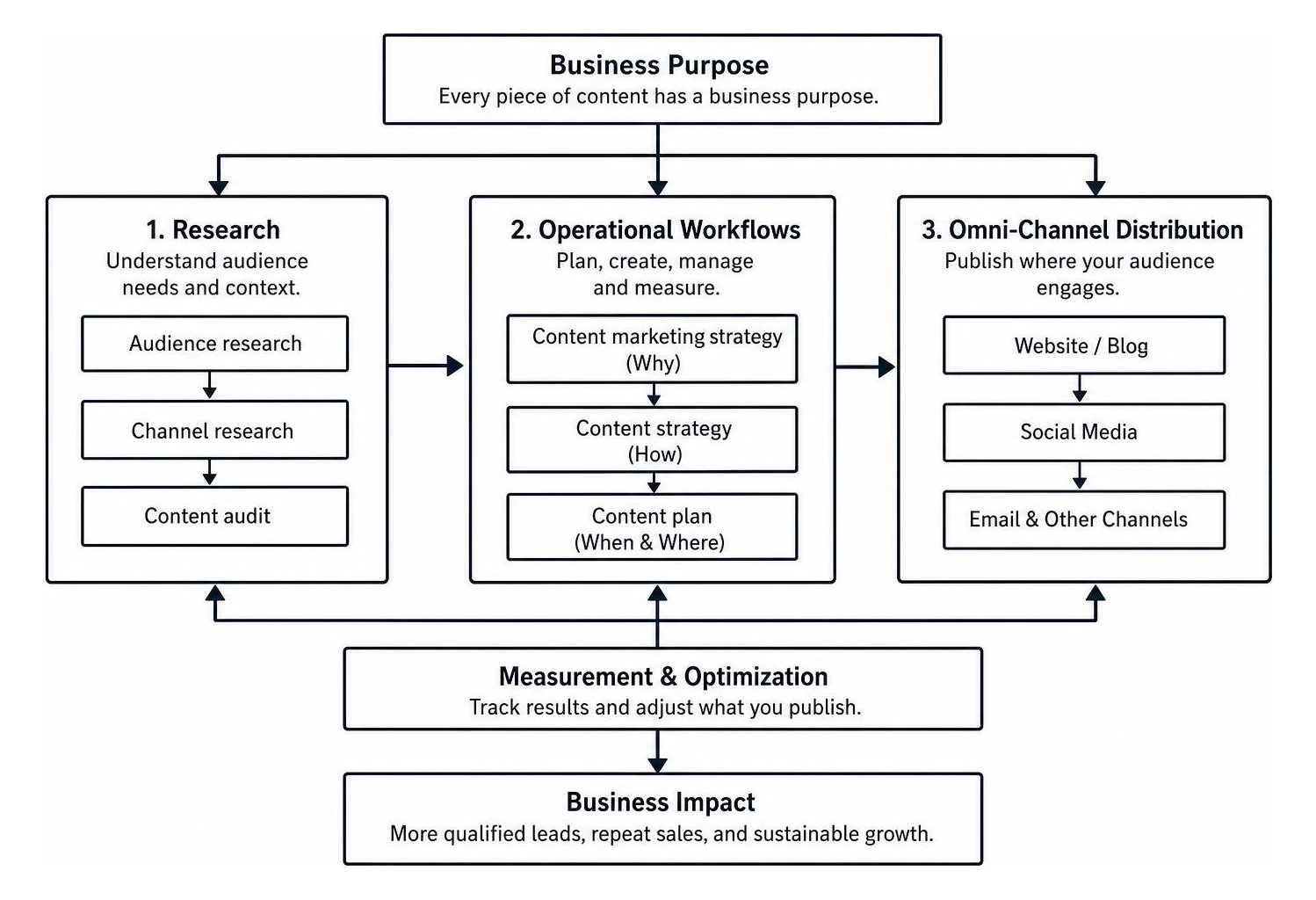
Content marketing and strategy work best when every piece of content has a business purpose. Start with a goal, such as more qualified leads or repeat sales. Learn what your audience needs, choose the channels they use, and plan content that helps them take the next step. Then track results and adjust what you publish.
A content marketing strategy explains why you create content and what it should achieve. A content strategy guides how that content is made and managed. A content plan sets out what you will publish, where, and when. Keeping these decisions connected helps a small team focus its time instead of posting simply to stay visible.
Content Marketing and Strategy: Foundations, Definitions, and Business Impact
Randomly publishing social updates, blog posts, or videos without a clear north star is the single fastest way to burn out your marketing team and waste valuable budget. True business impact happens when you connect every piece of creative media to tangible financial outcomes like customer acquisition, retention, and lifetime value.
When establishing the business case for your marketing initiatives, executive buy-in depends on demonstrating how organic content drives bottom-line metrics. Organizations that operate without a unified blueprint constantly suffer from cross-departmental silos, where marketing, sales, and product teams tell conflicting stories. Investing in developing a content marketing strategy eliminates duplicated effort, aligns internal messaging, and provides clear operational governance across your organization.
Core Differences: Content Marketing Strategy, Content Strategy, and Content Plan
Marketers often use these three terms interchangeably, but each serves a distinct role within your overall operations:
- Content Marketing Strategy (The "Why"): Focuses on the high-level business case and customer journey. It defines how content will attract, educate, retain, and convert audiences to achieve specific commercial milestones.
- Content Strategy (The "How"): Governs editorial standards, brand guidelines, taxonomy, content lifecycle, and structural creation processes across all internal and external touchpoints.
- Content Plan (The "When & Where"): Translates strategy into tactical execution. This is your operational calendar outlining specific topics, media formats, channel placements, asset owners, and target deadlines.
Understanding these distinctions ensures your team does not jump straight into tactical publishing before establishing why that content needs to exist in the first place. High-level planning creates a solid base for content marketing: the key to growing your business, ensuring tactical schedules always serve broader business goals.
Why Documented Strategies Justify Budgets and Improve Execution
A strategy locked in someone's head is impossible to scale or measure. Documenting your strategy in a centralized, accessible format gives your team operational clarity and helps justify resource allocation. In fact, 86% of decision-makers maintain or increase content marketing spend when plans demonstrate clear paths to customer acquisition.
Documented roadmaps streamline cross-departmental communication. When sales reps know what content is being published, they can share relevant guides with active prospects to accelerate sales cycles. Following proven academic frameworks on how to create a content strategy that drives results ensures your marketing budget is treated as an active growth engine rather than a passive operational expense.
Strategic Foundations: Research, Customer Awareness, and Audits
Sustainable marketing starts with deep audience research rather than assumptions. The average internet user spends roughly six hours and 40 minutes online daily, which means your content must cut through substantial digital noise. Finding resonant topics requires mining qualitative insights from sales calls, customer support logs, niche forums, and online communities like Reddit to uncover genuine customer pain points.
Understanding where content sits alongside your broader brand identity is equally important. While marketing focuses on communication channels and lead acquisition, your brand architecture defines your voice, reputation, and core values. Balancing branding vs marketing ensures that your content not only drives immediate clicks but also builds lasting brand equity and customer loyalty.
Aligning Content with Awareness Levels and Buyer Personas
Every prospect who interacts with your brand enters at a different stage of awareness. Tailoring topics to these distinct mindsets prevents you from pitching products prematurely:
- Unaware: The user does not yet realize they have a problem. Content should entertain, tell stories, or highlight broad industry shifts.
- Problem Aware: The user experiences pain but does not know a solution exists. Content focuses on diagnosing issues, explaining symptoms, and validating challenges.
- Solution Aware: The user knows solutions exist but is evaluating different approaches. Educational breakdowns, webinars, and comparison guides work best here.
- Product Aware: The prospect knows your brand provides a solution but needs proof of fit. Case studies, product walk-throughs, and free-trial offerings belong in this phase.
- Most Aware: The buyer is ready to purchase and simply needs final terms, clear pricing, or a seamless onboarding incentive.
Following a structured method allows you to map your editorial production to these awareness tiers, ensuring every buyer receives relevant information at each stage of their decision-making process.
Conducting Audits, Competitive Analysis, and SWOT Assessments
Before creating new assets, take inventory of what you already have. A comprehensive content audit systematically evaluates existing pages against key metrics like organic traffic, time on page, bounce rate, and downstream conversion impact.
Applying a classic SWOT framework helps reveal:
- Strengths: High-ranking evergreen articles, high-converting product pages, and standout lead magnets.
- Weaknesses: Decaying search rankings, outdated data, low-quality design assets, and missing calls to action.
- Opportunities: Unaddressed customer search queries, gaps left open by competitors, and high-performing text posts ready to be turned into video scripts.
- Threats: Competitors claiming top search rankings, changing algorithm criteria, or shifting buyer preferences.
Benchmarking competitor gaps alongside your own performance baseline highlights immediate opportunities to claim topical authority across your niche.
The Operational Framework: Goals, Formats, and Editorial Calendars
Operational execution is where strategy transforms into tangible business results. Without structured governance and clear ownership models, even the most brilliant marketing vision stalls. A complete operations plan defines production milestones, editorial review standards, brand voice guidelines, and publishing cadences. Establishing clear workflows around content creation allows small teams to produce consistent, high-impact assets without compromising on creative standards or missing deadlines.
Setting Actionable Goals and Objectives in Content Marketing and Strategy
Your strategic goals must follow SMART criteria (Specific, Measurable, Achievable, Relevant, and Time-bound). Generic goals like "increase social media engagement" do not provide actionable direction for creators.
Examples of effective, business-aligned goals include:
- Increase qualified inbound leads by 25% over the next two quarters through organic search traffic.
- Generate 500 product demo requests within six months by launching educational comparison guides.
- Boost email newsletter subscriber retention by 15% through curated industry insights and segment-specific campaigns.
Tracking pipeline velocity, customer acquisition cost (CAC), and customer lifetime value (LTV) alongside standard engagement data ensures that your creative outputs actively support executive business priorities.
Selecting Formats, Visual Assets, and Multi-Channel Calendars
Choosing the right mix of content formats depends on audience habits and team production capacity. High-performing campaigns leverage a balance of written, visual, audio, and video assets to reach users across multiple channels.
Visual assets are critical for maximizing engagement. Content that includes tailored graphics and infographics can see up to 650% higher engagement compared to text-only posts, while 84% of businesses using infographics on social media report finding them highly effective. To maintain a polished, professional identity across all touchpoints, investing in dedicated brand assets and high-quality brand photography gives your marketing materials an authoritative, trustworthy look that template stock photos simply cannot replicate.
Editorial calendars should track asset titles, target personas, awareness stages, content formats, primary distribution channels, assignees, and deadlines to keep production running smoothly.

Distribution, AI Integration, and Long-Term Content Sustainability
Publishing a great article or producing an engaging video is only half the battle. Without an active distribution system, even the best content goes unnoticed. Building real digital momentum requires nurturing the magic of engagement by building meaningful connections with your community, responding to comments, and encouraging conversations around your brand's core topics.
Omni-Channel Promotion Across Owned, Earned, and Paid Channels
A complete distribution framework balances three core channels:
- Owned Media: Channels you fully control, such as your website, blog, and email newsletter lists. Email marketing continues to deliver an exceptional return on investment, averaging $36 for every dollar spent.
- Earned Media: Organic reach driven by social media shares, customer reviews, press coverage, guest appearances, and natural backlinks from reputable publications.
- Paid Media: Targeted advertising across social platforms, search engines, and sponsored partnerships to amplify proven top-performing assets.
When using interactive promotional campaigns like contests, following established best practices for social media giveaways ensures you attract genuinely interested prospective customers rather than disengaged freebie seekers.
Integrating AI and Modern Discovery Paths into Content Marketing and Strategy
Search behaviors and content discovery models continue to evolve rapidly. Today, audiences find answers across search engines, conversational AI platforms, short-form video apps, and community forums. In fact, 90% of users now consider voice search faster and easier than traditional typing, shifting consumer search queries toward conversational phrases.
Generative AI tools are reshaping operational workflows. Roughly 71% of marketers expect generative AI to free up time for strategic planning, while 80% want automated systems to handle repetitive data tasks. Modern teams integrate AI for prompt research, topic ideation, draft outlining, and automated audience segmentation. Learning to navigate these shifts using insights from prioritizing your content marketing strategy in 2026 ensures your brand remains visible across AI summary engines, large language model answers, and emerging conversational discovery platforms.
Repurposing Workflows to Overcome Scaling Challenges
Producing fresh assets from scratch every day is unsustainable for lean marketing teams. A modular "anchor-and-spoke" repurposing workflow extends the lifespan and reach of every core piece of content you produce:
- Create an Anchor Asset: Produce one comprehensive, high-value asset, such as an in-depth research guide, proprietary case study, or podcast episode.
- Extract Written Snippets: Break the primary asset down into five targeted blog posts, several LinkedIn carousels, and an email newsletter series.
- Produce Short-Form Video: Convert key takeaways into quick vertical video scripts for Instagram Reels and YouTube Shorts.
- Design Visual Graphics: Turn statistics, comparison matrices, and core frameworks into standalone infographics for social sharing.
This repurposing model allows your team to maintain high editorial output while protecting creative bandwidth and ensuring consistent quality across every channel.
Frequently Asked Questions About Content Strategy and Execution
How often should a content marketing strategy be updated?
While your foundational brand mission and core business goals remain steady, your tactical execution plans should stay flexible. Review content performance monthly, conduct quarterly audits of channel metrics, and perform a comprehensive annual review to adjust for algorithm updates, new platform features, and evolving audience behaviors.
What metrics best prove content marketing ROI?
To prove genuine ROI to executive leadership, look beyond vanity metrics like raw page views or superficial social likes. Focus on commercial indicators such as conversion rates on landing pages, inbound lead generation volume, sales pipeline velocity, customer acquisition cost (CAC), and customer lifetime value (LTV).
What are the most common challenges in content marketing?
The three most common bottlenecks are limited internal resources, difficulty maintaining publishing consistency, and disconnected measurement systems. Teams can overcome these obstacles by implementing documented editorial calendars, establishing a modular repurposing workflow, and tracking direct conversions through integrated analytics tools.
Conclusion
Building a successful digital presence is an ongoing process of strategic alignment, creative storytelling, and data-informed refinement. When your content creation directly supports clear business goals, every article, video, and social update actively builds brand equity and fuels long-term revenue growth.
At The Small Social Company, we partner collaboratively with growing brands to build customized digital marketing frameworks that drive real business results. Discover how the power of storytelling in social media marketing can elevate your brand narrative, deepen customer engagement, and transform your content into a reliable driver of sustainable growth.