

Content Marketing Terms Demystified: Learn the Basics
Content Marketing: What It Is and Why It Matters

Content marketing means creating and sharing useful content for a specific audience. Instead of interrupting people with a sales pitch, it helps them answer a question, solve a problem, or make a decision. A helpful article, video, or email can build trust before someone is ready to buy.
For a growing business, the basics are simple: know who you want to reach, make content they need, share it where they spend time, and track whether it leads to meaningful action. You do not need to be everywhere. You need a clear reason for each piece you create.
The Small Social Company brings more than 14 years of marketing and agency experience to content marketing that prioritizes audience engagement and sustainable growth over vanity metrics.
What Is Content Marketing and How Does It Differ from Advertising?
At its core, content marketing is a long-term approach focused on building strong relationships with a target audience. Instead of pitching products directly, businesses provide high-value, educational, entertaining, or problem-solving materials. When done well, content transforms marketing from an operational expense into a lasting profit center.
Industry benchmarks from the Content Marketing Institute highlight that creating consistent, relevant material drives profitable customer action by earning attention rather than renting it. While traditional advertising rents space on someone else's platform to broadcast a message, content marketing builds your own digital media assets.
Understanding this distinction requires clarity on foundational concepts like branding vs marketing. Branding defines who you are and what values you stand for, whereas marketing encompasses the tactics and campaigns you deploy to communicate that identity and drive customer action.
Defining the Digital Publishing Approach
Adopting content marketing means thinking like a digital media publisher. Rather than pushing out one-off promotions, brands curate an ongoing library of helpful resources that serve customer needs over time.
Today, delivering customer-centric value generates compounding inbound leads, strengthens brand loyalty, and provides evergreen value that outlasts any single advertising sprint.
Key Differences Between Content Marketing and Traditional Ads
Traditional advertising relies on interruption. Commercials break up television shows, banner ads clutter page margins, and direct mail fills physical mailboxes. Content marketing, by contrast, operates on an inbound, organic pull model.
| Feature | Traditional Advertising | Content Marketing |
|---|---|---|
| Primary Mechanism | Push (interruption-based) | Pull (discovery and value-driven) |
| Audience Mindset | Passive or resistant | Actively searching for solutions |
| Asset Longevity | Temporary (ends when budget stops) | Evergreen (compounds over time) |
| Trust Dynamics | Skeptical of direct claims | High trust built via education |
| Cost Profile | Ongoing media spend required | Upfront creation cost with lasting value |
When prospects discover a solution through educational material, they feel empowered rather than sold to. Understanding the psychology behind digital marketing shows that consumers naturally build trust with brands that respect their autonomy and offer answers before asking for a purchase.
Core Types of Digital Media and Formats
Modern audiences consume information across multiple touchpoints and in various formats. A balanced content strategy utilizes an omnichannel delivery model, pairing written analysis with visual and audio elements. The visual presentation of your message is critical; knowing why good quality images sell products ensures that every visual asset reinforces professionalism and boosts conversion potential.
Long-Form Publications, Blogs, and Case Studies
Written content remains the cornerstone of search visibility and deep customer education. High-quality articles, guides, and research reports position your brand as an authoritative voice in your field.
- Search Engine Visibility: Websites with active blogs maintain 434% more indexed pages and earn 97% more inbound links than sites without active content.
- Lead Generation: Companies that maintain active blogs generate 67% more leads monthly compared to those that do not.
- Deep Consideration: Formats like white papers remain essential for complex purchase decisions; 56% of marketers use white papers, and 67% of top-performing businesses rely on them to establish authority.
Publishing structured, informative articles is a proven method for businesses looking to expand their digital footprint. Leveraging content marketing to grow your business gives potential buyers the detailed information they need to evaluate their choices independently.
Video, Audio, and Visual Storytelling
Visual and auditory media capture attention quickly and simplify complex topics for busy audiences.

- Video Production: Video has become indispensable. 91% of content marketers use video as a core marketing tool, and 78% plan to increase production. Furthermore, 90% report that video significantly boosts brand awareness, while 88% note that it helps users better understand their offerings.
- Infographics and Visuals: Over 60% of businesses incorporate infographics into their strategies, with 84% finding visual storytelling on social channels effective. Content containing images and graphics achieves up to 650% higher engagement than text-only posts.
- Podcasts and Audio: With approximately 505 million podcast listeners globally, audio marketing offers an intimate channel for customer engagement. Among Gen Z listeners, 82% have taken action and 61% have visited a website after hearing a podcast sponsorship.
To stand out in crowded feeds, companies must invest in original media rather than generic stock imagery. Understanding why you need brand photography and having a clear view on why you need brand assets ensures that all multimedia collateral remains distinct, recognizable, and aligned with your core messaging.
Building a Resilient Strategy Across the Buyer Journey
A successful marketing strategy requires moving beyond spontaneous posting to a structured publishing workflow. Partnering with professionals for content creation helps organizations establish the frameworks, editorial calendars, and multi-channel plans necessary to sustain consistent output.
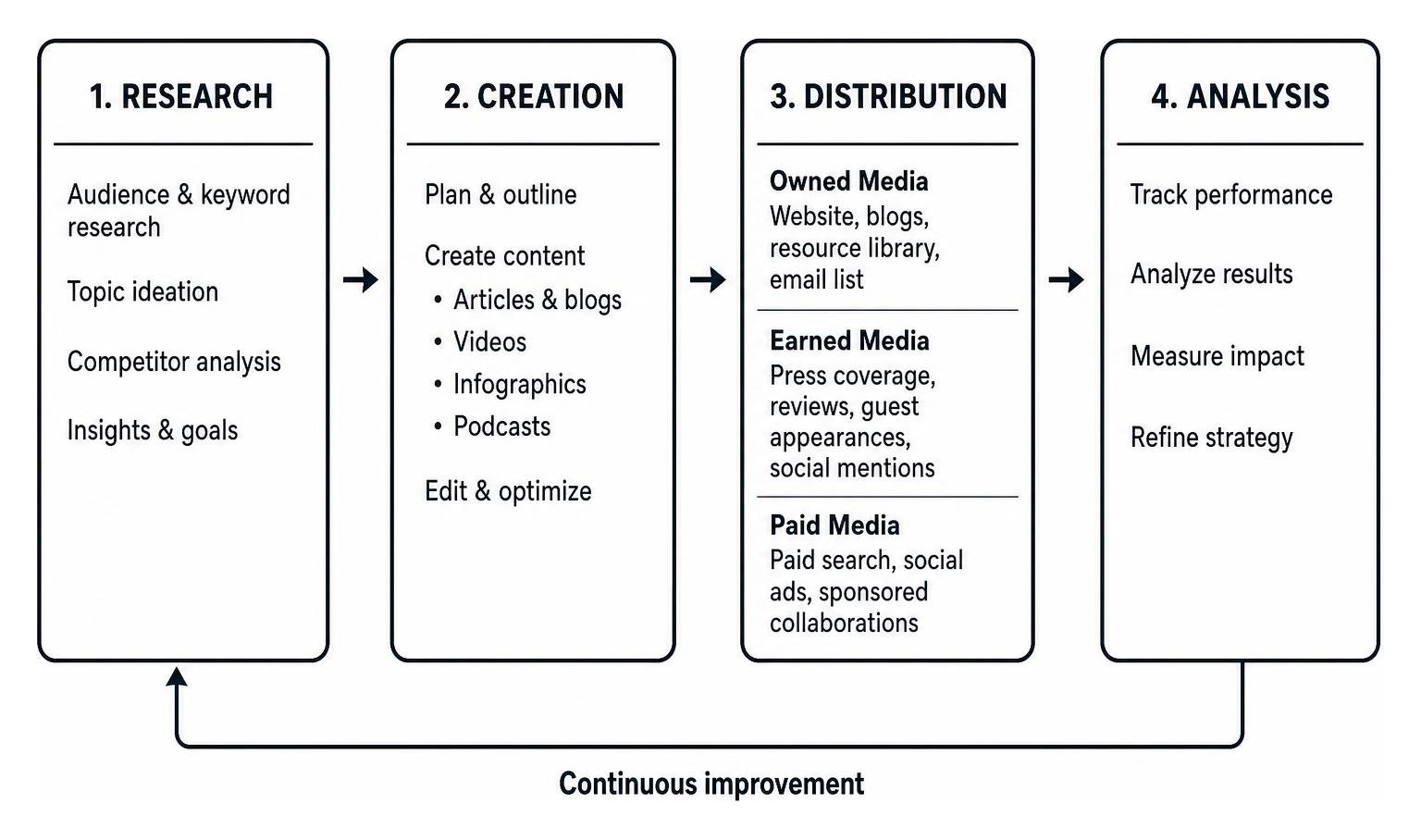
A comprehensive distribution framework organizes channels across three primary categories:
- Owned Media: Assets fully within your control, including company websites, blogs, resource libraries, and email subscriber lists. (Email marketing continues to deliver an average return on investment of $36 for every dollar spent).
- Earned Media: Organic word-of-mouth visibility, including press coverage, customer reviews, guest appearances, and organic social mentions.
- Paid Media: Targeted amplification methods, such as paid search, social media advertising, and sponsored collaborations.
Audience Research and Funnel Mapping
To guide prospects effectively, content must match their mindset at each stage of their journey:
- Top of the Funnel (Awareness): Prospects are identifying a problem. Deliver broad educational guides, introductory videos, and infographics. Address search intent directly through zero-click optimization—providing clear, immediate answers that establish credibility.
- Middle of the Funnel (Consideration): Prospects understand their issue and are evaluating potential solutions. Offer comparison guides, technical white papers, case studies, and webinars that highlight specific methodologies.
- Bottom of the Funnel (Decision): Prospects are ready to select a provider. Provide clear product walkthroughs, transparent implementation timelines, pricing calculators, and direct customer testimonials.
Measuring Content Marketing Performance and ROI
Despite 70% of organizations creating more content year-over-year, only 21% of marketers feel confident in their ability to track return on investment. Aligning metrics with concrete business objectives resolves this disconnect.
- Brand Awareness & Reach: Organic impressions, unique website visitors, and audience growth across digital platforms.
- Engagement & Health: Average time on page, scroll depth, social sharing, and brand sentiment.
- Pipeline & Conversions: Email sign-ups, lead capture rates, webinar registrations, and attribution-tracked demo requests.
- Customer Retention: Churn reduction, repeat orders, and overall customer lifetime value.
Navigating Operational Challenges and Future Trends
Modern marketing teams manage extensive responsibilities across dynamic platforms. Over 20% of marketers wear ten or more distinct functional hats, while 54% handle tasks outside their original job descriptions, including project management, analytics, and community management.
To maintain quality without burnout, organizations turn to dedicated partners to level up their brand presence with content creation, establishing structured workflows that ensure sustainable production.

The Strategic Impact of Artificial Intelligence
Artificial intelligence is reshaping how organizations conduct research, organize workflows, and analyze audience behavior. Nearly 80% of marketers dedicate personal time to learning new skills, with 39% focusing specifically on AI automation.
AI tools excel at processing large datasets, identifying emerging search queries, and assisting with content repurposing. However, technology cannot replace genuine brand perspective. High-performing content balances efficient AI data analysis with authentic human storytelling, emotional resonance, and lived industry expertise.
Frequently Asked Questions About Organic Media
How does value-driven material drive measurable sales revenue?
Content drives revenue by answering buyer questions, reducing friction during the evaluation process, and nurturing leads over time. By providing transparent, comprehensive resources, businesses shorten sales cycles and attract higher-intent prospects. Over time, organic search rankings and compounding referral traffic lower customer acquisition costs compared to continuous reliance on paid advertising.
What makes a campaign achieve viral reach?
There is no formula that guarantees virality. However, campaigns that earn broad reach typically share distinct characteristics: they evoke strong emotional resonance, present proprietary data, deliver humor, or provide interactive value. For example, Spotify Wrapped achieves over 1.2 million social mentions each December by transforming personal user listening data into highly shareable, visually engaging graphic cards.
Contact The Small Social Company
Content marketing is a sustainable, compounding engine for long-term digital growth. By moving away from aggressive sales pitches and toward educational, customer-focused publishing, businesses establish genuine digital authority and earn lasting customer loyalty.
If you need help turning content marketing into a practical plan for your business, contact The Small Social Company. Our team can help you clarify your message, choose the right channels, and build content that supports meaningful engagement and long-term growth.